
Reunion of 71 Aggers - 2026 - Hunter Valley
We enjoyed a great roll-up of ‘71 Aggers’ and their partners to our recent reunion. Check out the images below to see how great we all look!
Then, see below for some of the talks that we heard on the night. We had a great time!
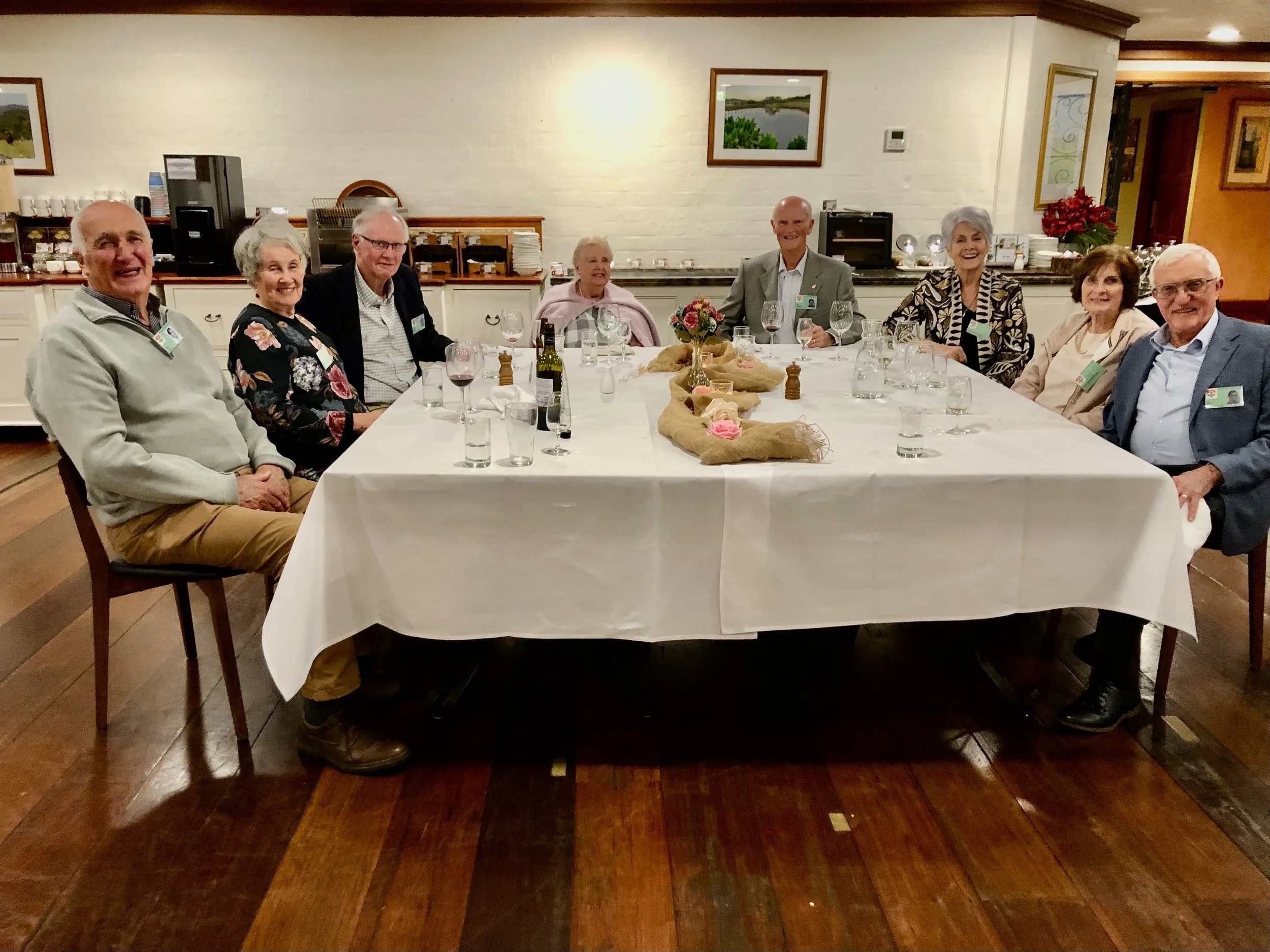
L to R: Dan Ryan, Ronnie Ryan, Frank Nicholas, Jan Nicholas, Pete Sydney, Helen Sydney, Pat Bowditch, Ron Bowditch
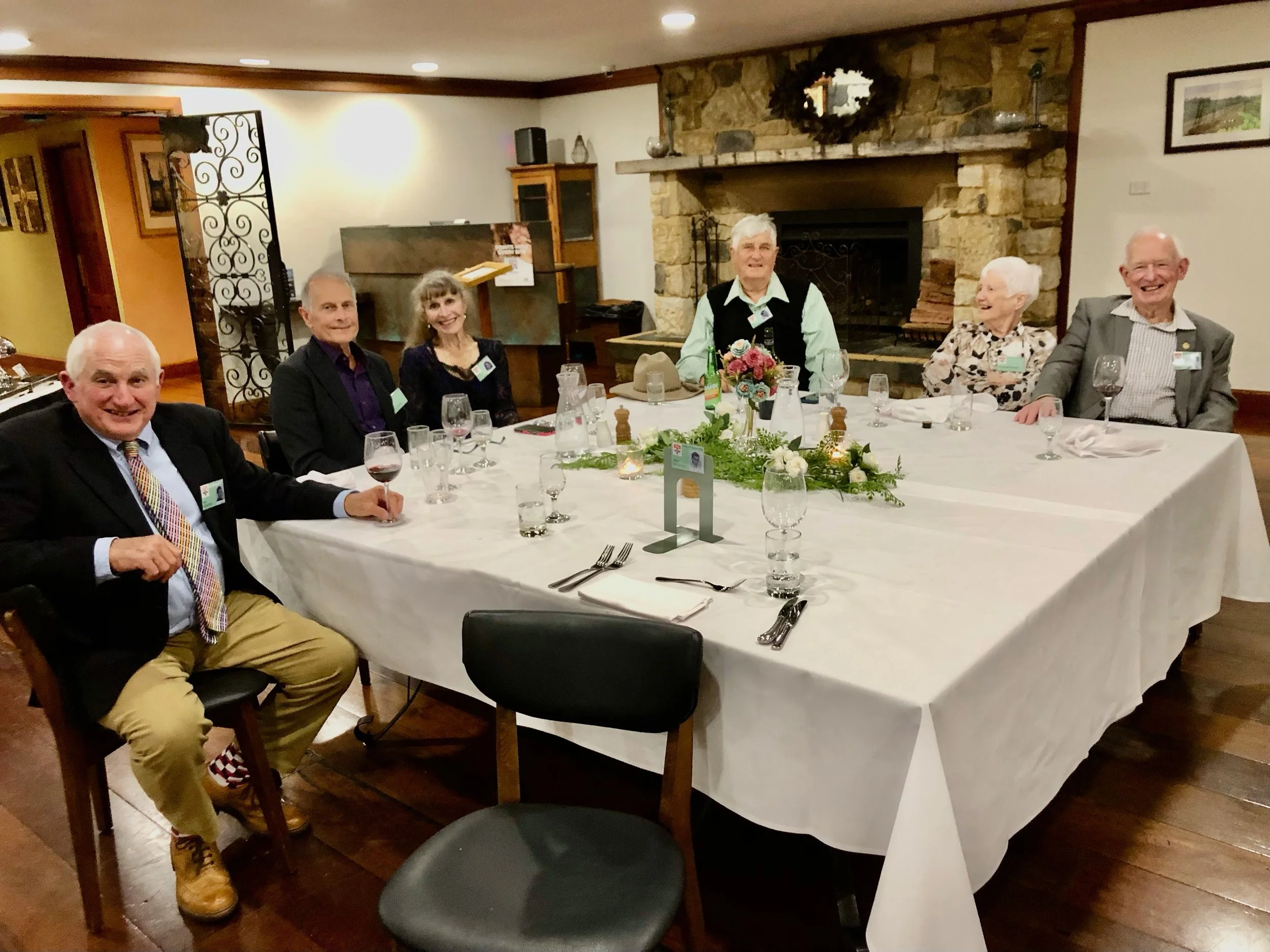
L to R: Mal McNiven, David Zaman, Helen Zaman (nee Weiler), Bob Maxwell, Pauline Black, Neil Black
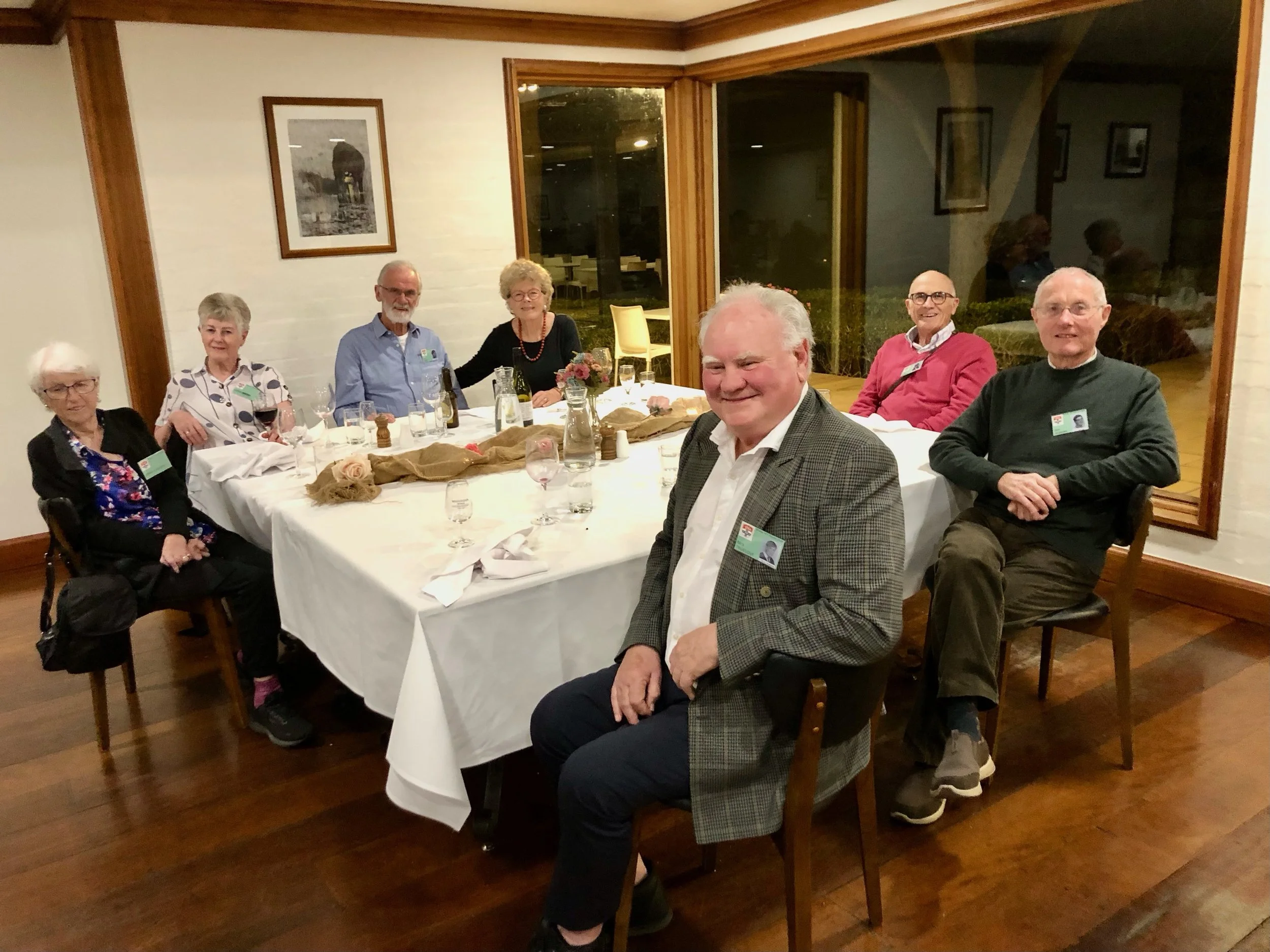
L to R: Jenny Hawkins, Verna Parker, Jim Scott, Mary Ann Scott, Nick Truelove, Lisle Brown, Stuart (Sam) Hawkins
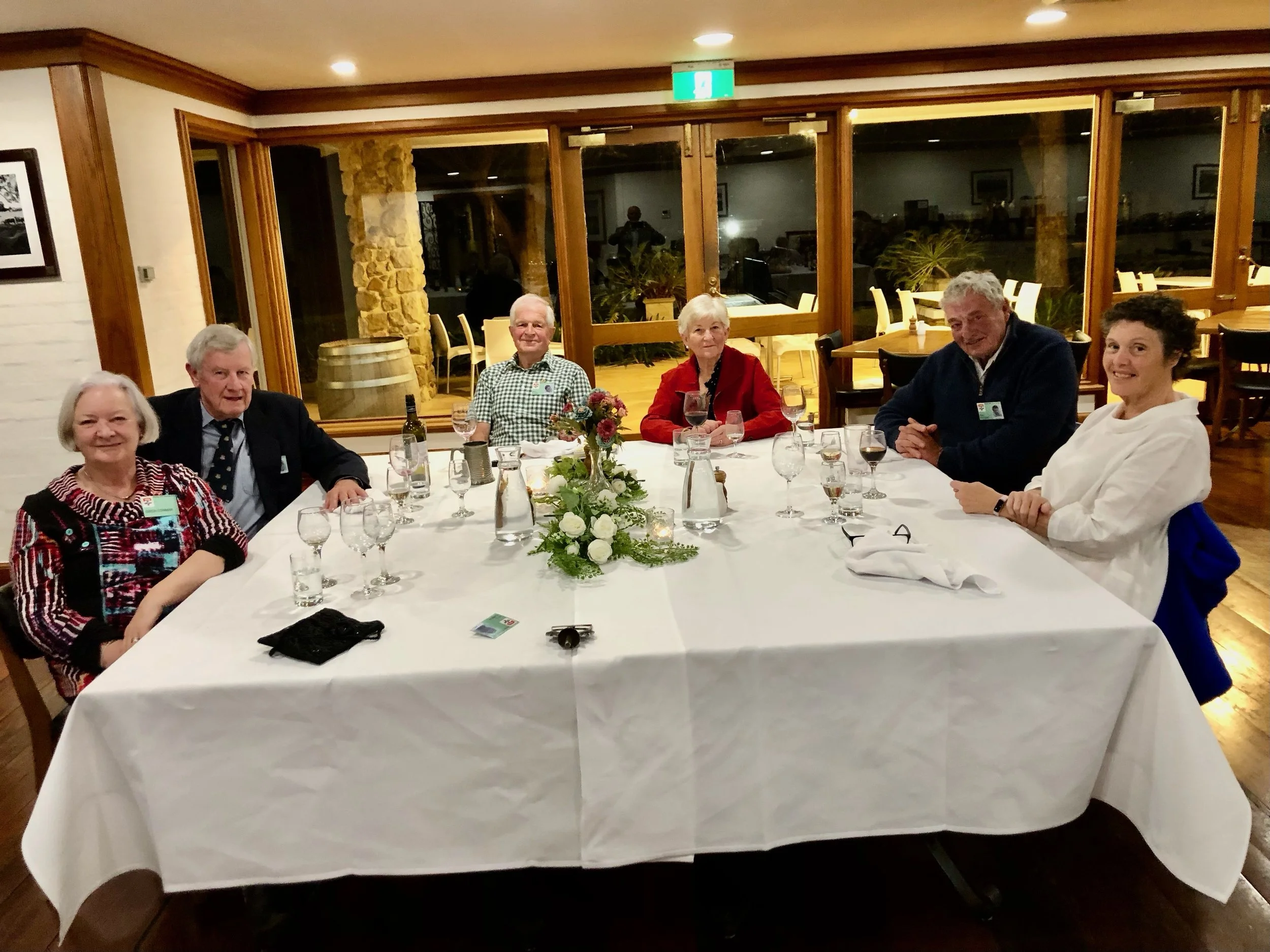
L to R: Gwen Cowman, Peter Cowman, Mike Titley, Heather Titley, Pete Nethery, Robyn Nethery
Frank Nicholas
I'd like to start by mentioning Jan, who's here with us tonight. As many of you know, she's been part of the of the class of '71 since 1967, when many of us started. Jan and I met in Orientation Week of that year, when we were both in first year. She was in Arts, and I was obviously in Ag Science. We've been together ever since. She's had recent medical challenges, and that meant that we weren't able to come to the previous reunion, but she's really thrilled to be here tonight.
Some of you may remember that we actually got married in 1969, when I was in third year. Some of you got together and bought us a wedding present ─ a vertical griller ─ which was presented to me during a genetics prac class in the Badham Building. We've never forgotten the gift of a vertical griller from what became the class of '71!
The story that I mainly wanted to tell tonight is to do with a wonderful coincidence. We're here at the Mercure Hotel at the junction of Broke Road and McDonalds Road in the Hunter Valley. It just so happens that I did seven weeks of practical work up here on a new vineyard that comprised three paddocks that all met at this junction, where we are having this dinner. You'll remember that one of the requirements of the Ag degree was that we had to do 18 weeks of practical work, and we had to write reports about those weeks. I'd grown up on a wheat-sheep farm, so I didn't need to do any work in those aspects of agriculture. But I did need to learn about other aspects of agriculture, one of which was viticulture, about which I knew absolutely nothing.
Somehow, I managed to organize a job with a very new company called Hungerford Hill. It had started only two years previously (in 1967, the same year that we started uni), and it was based right here at the junction of McDonalds and Broke Roads. The three paddocks of the new vineyard had been a dairy farm called Hungerford Hill, owned by a man called Hungerford. The paddocks were located on three sides of the junction of Broke and McDonalds Roads: the north-western side, the south-western side, and the south-eastern side of the junction.
The company’s aim was to plant the whole of the 854 acres of the dairy farm to vines. The first thing they had to do was to knock down all the trees, as one did then. They brought in a big bulldozer to do that in 1967, and then planted some vines on the north-western block in 1968. Then I got this job at the beginning of 1969. The bulldozer had windrowed up all the wood from the trees that were pushed over, but there were still a whole lot of smaller sticks in the paddocks. My job for most of the seven weeks was (as part of a team of around 6 people) to walk up and down the south-eastern and south-western paddocks, picking up sticks and throwing them into a trailer pulled by a tractor. My other job was weeding, i.e. hoeing weeds away from the young vines on the north-western block.
It wasn't a very challenging or educational experience as far as work was concerned, but I was very fortunate to be mentored by the young manager, Simon Currant. He'd been employed by Hungerford Hill to manage the development of the of the vineyard. The team of navvies (of which I was part) started work at 7 in the morning and finished at 3 in the afternoon. Then Simon would sit down with me after the team had finished work and would talk about his management role. In this way I learned a lot about viticulture.
It just so happened that Simon was being mentored by Murray Tyrrell, whose vineyard was up Broke Road a bit. Some afternoons, Simon would go up to Tyrrells and sit down with Murray for a chat, and Simon would take me along to those discussions with Murray. So, I had this magical experience of sitting down with one of the pioneering legends of Hunter winemaking, hearing his life experiences and learning lots about viticulture and winemaking.
One of the interesting offshoots of this was that Murray Tyrrell was involved in another new company called Rothbury Estate, which had been formed in 1968, only just the previous year, by Len Evans ─ another legendary figure in the Australian wine sector. It was going to have a winery and a vineyard just a bit further up McDonalds Road. At the end of my prac work, I was actually offered a managerial job on the Rothbury Estate vineyard, on the strength of my picking up sticks and hoeing weeds for 7 weeks at Hungerford Hill! So, I had a bit of a decision to make: would I accept this role or would I continue with my Ag Science degree? In the end, Jan and I decided that I would continue with my Ag Science degree. A sliding-door moment.
Postcript
As it happens, none of those three paddocks on which I worked is now owned by Hungerford Hill, reflecting financial upheavals in the company in the 1980s. However, the company still has a major presence in the Hunter Valley, having acquired (among other things) Dalwood Estate, the oldest continually-running vineyard in Australia (started in 1828). Also, for the last 20 years or so, there has been a Hungerford Hill winery/cellar door/tasting room/restaurant at the eastern end of Broke Road.
The day after the dinner, Jan and I called in there on our way home. I showed the woman behind the counter a photograph I'd taken of the south-eastern Hungerford Hill block, from the road junction, back in 1969. She said, "Oh, I've got to show this to the boss", and called the boss in. He turned out to be Pierre Durand, only recently appointed (in July this year, as I later learned) as the general manager and chief winemaker of Hungerford Hill! Being new to the company, Pierre had been trying to learn about the early years of Hungerford Hill, especially given that next year, 2027, Hungerford Hill celebrates its 60th anniversary!
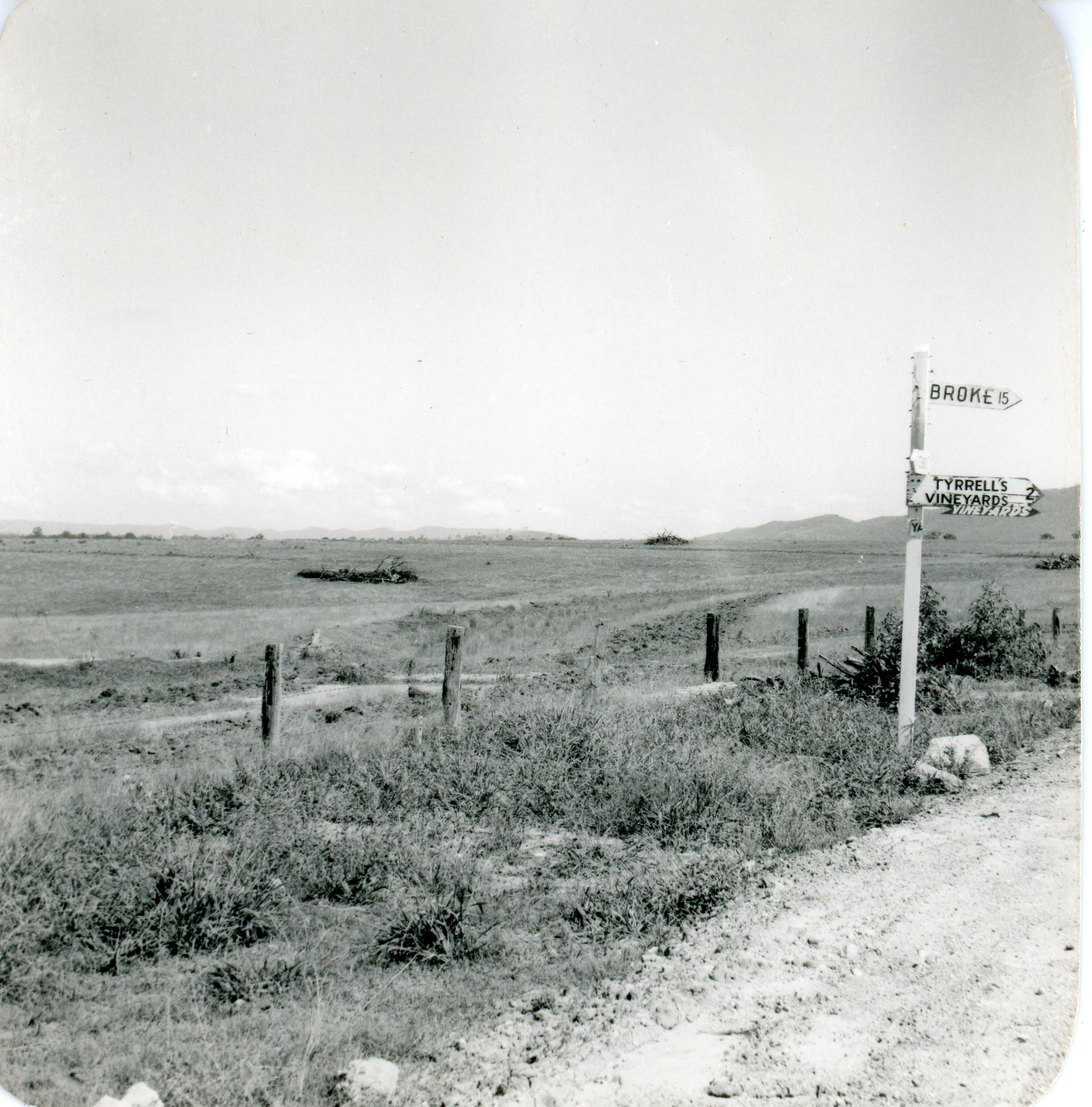
1969: Land being prepared for Hungerford Hill vineyard at Broke Rd intersection.
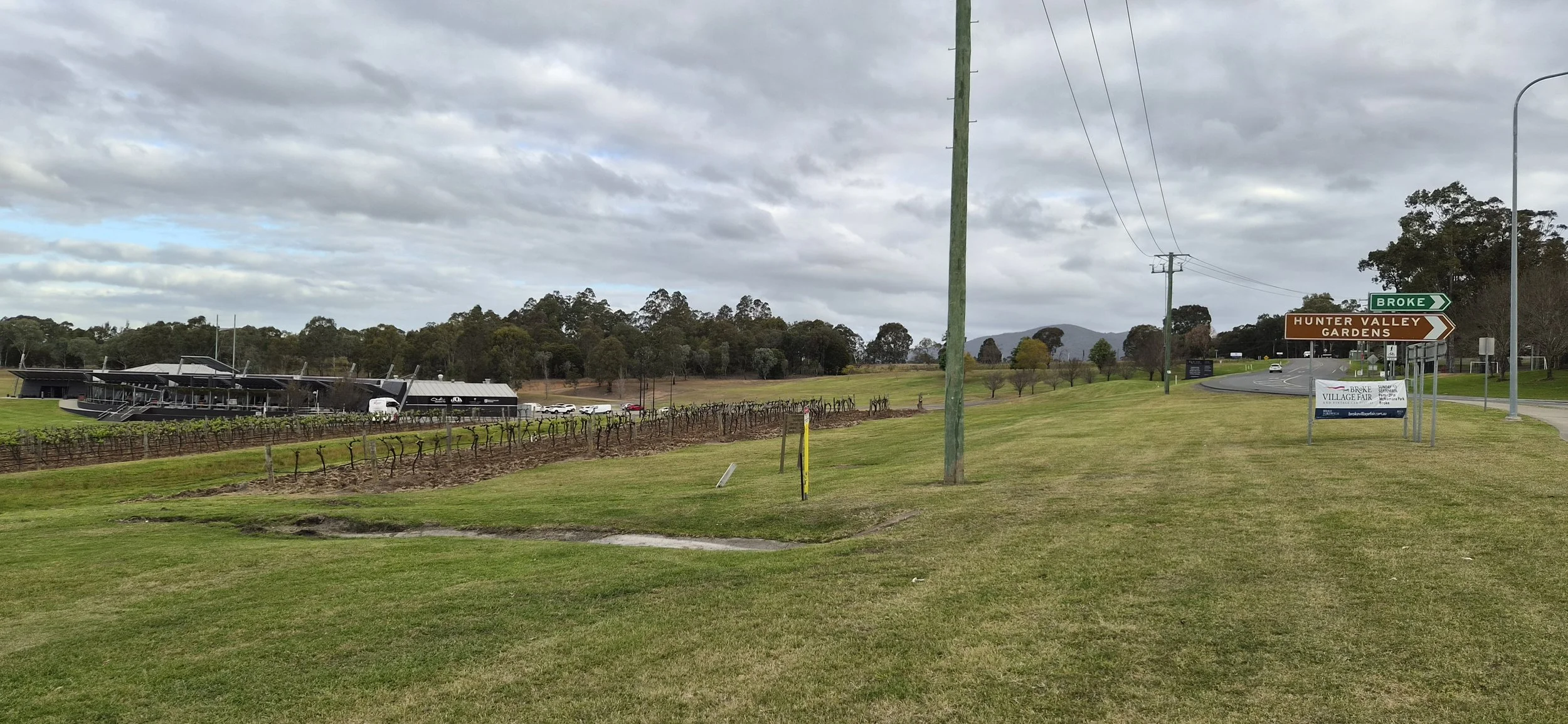
2026: Photo of land originally prepared for Hungerford Hill at Broke Rd intersection.
I told him that I'd written a report about what the company had been doing on the original Hungerford Hill paddocks, and he got really interested in that. He was also really interested in the photograph. I've now sent him all four photographs I took of the three paddocks, and a copy of the report. Understandably, he had no idea that anything like that report existed. I was also able to introduce Pierre to Simon Currant ─ now in his mid-eighties – having moved to Tasmania after his foundational years at Hungerford Hill. No doubt Simon will be able to provide Pierre with a thorough account of the early years of Hungerford Hill.
The happy end to this story is that Jan and I (and we presume Simon) are now invited to the 60th anniversary celebrations of Hungerford Hill next year.
Pete Sydney
When I completed my four-year degree in November 1970, I applied for several positions in several states and departments, one of which was with the Department of Primary Industries in Brisbane. Soon after my application I received a call from the Director of Marketing. He was in Sydney with his Deputy and were staying at a hotel in Kings Cross and asked if I'd like to go there for an interview. When I arrived at the hotel, the Director said, "Look, we won't take long for a chat, but we're going to have a few drinks first and proceeded to order three “ponies”, which were seven-ounce glasses. We sat down, had a beer, had a chat for about 10–15 minutes or so. Then I thought, "Well, that'll be about the end of this interview. I'll ask a few more questions and I should be right to go. Not at all. "you're good to go again” said the Director and so we had another round. By the time that round finished, I was feeling a little bit under the weather. I thought, oh well, I'm going this time. I'm sure they'll finish up now. “Now one more round to go”, said the Deputy By the end of this time, I was really under the weather!
At the end of the “interview”, the Director said, "Oh, that was a good chat." I stumbled out of the hotel and made my way home – not quite sure how long it took me to do so though. Eventually, I received a letter in the mail a week later saying I got the job as a Marketing Officer.
When I was working in the marketing area in Queensland, Sir Joh Bjelke-Petersen was still in power. Several times we used to go across to Sir Joh's office, which was very close to Parliament House and the building where I worked. On one occasion, we had a nice meal in his office. While having a chat, I noticed a well-dressed chap bringing in a large brown paper bag into his office. I thought it was a bit strange someone bringing his lunch into Joh’s office.
Part 2: Experiences in Western Australia & Kununurra
In 1973 while working in the Department of Primary Industries in Canberra, I had the opportunity to go to Perth. A scholarship was being offered for a marketing officer for one year to work in Perth and study. It was an interchange program, which meant swapping houses and swapping jobs with an officer from marketing in Perth at the Department of Agriculture. I was awarded the scholarship for which I was very fortunate.
My task was the economic analysis for the Ord River Scheme, looking at crops like navy beans and others being grown under irrigation. The whole family took the train across on the Indian Pacific with the car and stayed in Perth for the year. As part of my four or five trips up north, I flew to Kununurra from Perth to conduct cost-benefit and economic analyses on various crops that were being trialled. It was a very enlightening experience given the sheer scale of the Ord Scheme, the massive amount of water held and my recollections of Bruce Davidson's book, “The Northern Myth.” It was a very interesting 12 months.
During my time there I heard a few stories about locals in the Kununurra area which was a bit of a wild "wild west" town at the time. One story involved a local character – a farmer who was a bit eccentric. On one occasion, at a gathering of local farmers, I was told his phone rang but instead of answering it, he pulled out his handgun, aimed at the phone, smashing it into pieces much to the amazement of everyone there! I was told it was a true story.
Mike Titley
My ‘pivotal event that impacted on my career’ occurred during my first position at ‘Kyeema’ a 2,500 acre property owned by the Lewis family who had recently sold their company Master Foods to the USA food company Mars Corporation. I was employed by Byron Agricultural Company owned by the family as their research agronomist commencing 1st January 1971.
The General Manager, Hugh Moore, prior to being appointed was boss of the Mountain Maid cannery at Batlow, with no vegetable agronomy background. My boss was Alan Wray, an ex-Department of Ag rice agronomist, who also had no vegetable crop experience. I was the vegetable agronomist two months into a 50-year career.
‘Kyeema’ soil type was a red brown earth, land-planed and set out for furrow /flood irrigation with a large irrigation licence from the Macquarie River, 2 km away.
The main summer crops were soybeans, sorghum and maize and a 25-acre crop of pickling cucumbers (gherkins) grown under contract for Master Foods.
The Burrendong Dam was 95% full when heavy flooding rains fell in late February in the headwaters of the Macquarie River causing a major flood. We had to be flown into the property every day as the dam released a massive amount of water, flooding the road to Trangie and the property west of Narromine for ten days
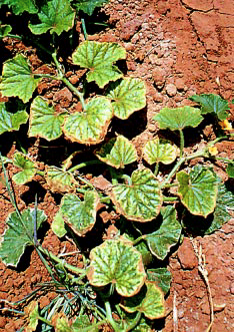
Mo deficiency in cucurbits
The gherkin crop was progressing well with flowering commencing at full canopy during this time. However, after my daily crop inspection, I noticed stunting and failure of leaves to develop a healthy, dark green colour. The leaves of affected plants show a pale green or yellowish green colour between the veins and along the edges. In advanced stages, the leaf tissue at the margins of the leaves was dying. Growing up on a central coast dairy farm with acid soils, I recognised this as molybdenum deficiency. I consulted with Hugh and Alan and they approved that I get the aerial spray operator from Narromine to apply a spray of sodium molybdate as we couldn’t spray with a ground rig as it was too wet.
Consulting Knotts Vegetable Growing Handbook, I recommended 500g sodium molybdate (40% Mo) / acre to be applied early in the morning before the heat commenced.
Three or four days later, I noticed marginal leaf scorching, necrosis , rolled and cupped leaves and I panicked. I rang Eric Darley from the Department of Ag from Dooralong farming days who had recently taken a new job as the Department of Ag chief vegetable agronomist. He immediately asked how much water was used and I checked with the pilot who said it was 3 gallons/acre. Eric immediately replied that to apply foliar sodium molybdate at that rate, it had to be at 100 gallons/acre.
I was shattered! The result was that I had almost completely defoliated the crop! However, growing into some cooler autumn weather, we did salvage half our contracted amount for Master Foods.
I learnt an extremely important lesson: read the recommendations thoroughly, consult with the spray operator, don’t apply when daytime temperatures are greater than 28 degrees C and consult with senior agronomists. Every time since then, when I see trace element recommendations from soil of leaf tests, I thoroughly work through the rate and water required for foliar sprays.
Now I will summarise ‘who had the most influence on the direction your career/life took’?
That person is my wife of 56 years, Heather, who I married in August 1970 in my final year and got me focussed on writing up my thesis and studying more thoroughly for the end of year examinations in fourth year.
During my first job at Narromine, Sharon was born; during my second job at Stuarts Point, Brendan was born, whilst during my third job at Queensland Agricultural College at Gatton, QLD, Peter was born.
We moved 22 times in our first 17 years including a sabbatical in Gainesville, Florida, USA for six months before relocating to Sydney and no more children.
Heather put her own profession on hold until we relocated to Sydney and then had a successful retail and corporate banking career for 20 years.
Now, nearly 40 years later, she has supported my careers in the vegetable seed industry, processing potato industry, the QSR fresh salad industry and then as joint partners in my vegetable consulting company. Over all of this time, Heather has held the family together whilst I travelled extensively nationally and internationally many times and for long periods. I couldn’t have done the work I loved and enjoyed without her unconditional support. I realise that there are many wives of my colleagues that have experienced similar support.
Sincere thanks H and all my love.
Ron Bowditch
I was a city boy who had a rather unorthodox entry to Ag Science. The nearest to a farm I'd ever been at was my grandfather's garden, where he had a few chickens and a few tomato plants! In the year between the Leaving Certificate and the Wyndham scheme, I started to study Geology at the Institute of Technology, which later became the University of Technology.
At the time, I had in my mind to get a degree in geology. So, I was studying four nights a week, but I needed a job in the daytime, and so I got a job in the Public Service. The job interviewer asked: "What department would you like to work in?" He had a stack of job cards. This was 1966 – and this doesn't happen now – but the stack of cards was large! He started at the top, "Agriculture," then he said, "Attorney-General," and I thought, "Oh no, he's going to go through the whole alphabet." So I said, "Agriculture is fine." And so I started at the bottom as a junior clerk in the head office at the Department of Agriculture in Sydney, which was handy because it wasn't far from where I was studying.
After a while there, a senior person asked me what I was studying, and I said, "Science." He said, "We have scholarships in Agricultural Science. You could apply for one, which would be easier than working full time and studying”. So I did. I knew nothing about it. I had the interview the day after my first year Institute results came out and I got the scholarship.
Ag Science really opened my eyes. The diversity of people in our year – everyone from farmers on big properties, to farmers on small properties, to people who weren't in farming at all but had other interests, plenty of different backgrounds, every different experience, perspective, and from everywhere in Australia and Asia.
It was an eye opener to spend time working with so many different people, with their different backgrounds, opinions and ways of life. An example of the differences between people was one I sometimes carpooled with - I won't mention his name. He always carried a gun in the car. I asked him why. “To euthanise any injured kangaroos”. Hmm, you don't see a lot of kangaroos on Victoria Road, but you never know.
At the other end of the spectrum, I was driving to a uni event in Lismore with Andy Yong. The deal was that he would provide the fuel and I'd provide the car. Well, the fuel he provided was a large quantity of roast pork! On the way to Lismore, he revealed his secret vice, which was photographing steel bridges. In those days there were a LOT of steel bridges between Sydney and Lismore on the Pacific Highway. That slowed the journey down, but we were well fed.
It wasn't just the different people, but the different subjects too – physics, chemistry, soil science, economics, botany, animal physiology, animal husbandry, entomology et cetera, etcetera. Like studying weather and climate in the morning and bacteriology in the afternoon. This diversity of subjects did not make us expert in all those things – nobody could be an expert in twenty different things. But it opened the door to each one, gave us the skills to look inside each one, become familiar with the basic concepts and terms and comfortable with switching from one to another. Most important, the thread of agriculture linked them all together. This was another eye-opener. There are links everywhere, between economics and plant genetics, for example. Ag Science revealed those kinds of links.
Thanks Ag Science. That spurred a lifelong interest to me in almost everything. So current interests include native orchids, animal pandemics, philosophy, anything to do with science, history, economics and many other things, and the connections between seemingly disparate things.
The practical requirement was another source of a wide range of experience and interest. Wheat, sheep, cattle, orchards, chickens, cotton, fighting bushfires, building fences, a stint in the Botanic Gardens, another in a winery, and one on a farm growing turf (and tortoises for the pet trade). A new experience was to drive a modified 3-tonne truck to the silo with 11 tonnes of grain on board! Don't mention the brakes!
An influential person for me was Professor Neville White in plant pathology. He had a saying that anything worth saying can be said in 200 words. For example, he set a textbook about 2 inches thick on the table and said: "200 words." I managed to get it down to 204 words. "Not good enough," he said, and showed me how I could easily condense it to 196. Now, I must admit that verbosity is still a weakness of mine, but at least I have this inspiration and goal to aim for and, sometimes, to put a check on my excesses.
After graduating in plant pathology, I worked in the Riverina on potatoes, fruit trees, cereals and so on. I had to return to Sydney for family reasons, and the only way of avoiding paying back the cost to the State of my scholarship, was to study more. The job to follow didn't suit me. So, when the time of my bond was up, I wanted to go back to science.
My lovely wife Patricia used to look through the job ads for possibilities. I had to read them before I complained about work. I was soon simultaneously shortlisted for two jobs: one a technical manager of a conglomerate of four potato farms, and the other was a job in human pathology – yes human pathology – working in the diagnosis of cancer and pre-cancer. They only needed a biology degree, and there was informal on-the-job apprenticeship training. That job came through first, so I took it.
Ag Science gave me the confidence to do something different, to find the connections, to build on what you already know. I fell on my feet in this field and really loved it. Within 7 years I was training new graduates, doing research, refining diagnostic criteria and developing an accreditation system. My research colleagues and I were able to improve the accuracy of diagnosis and deliver the findings to diagnostic scientists and pathologists worldwide through publications, travel, conferences, foreign aid and so on.
I was given some space to pursue side issues not normally part of my work. I had realised that the conventional wisdom explaining why people make diagnostic mistakes was wrong, because it assumed that people made mistakes because of something they didn't understand or know. That wasn't the case. Mostly, when shown a mistake on review they'd say, "Oh shit! I knew that. I don’t know how I missed it”.
I started working on understanding perception, the limits of vision, cognitive biases, attention capture and search patterns, and realised that diagnosis could be improved by attention to these. I developed and tested a different visual search strategy and was able to write it into workshops, training programs and a textbook. It became very influential in Australia, New Zealand, the UK, and Europe but, curiously, not in the USA. I think that they tend to not embrace ideas that come from somewhere else – or maybe from an upstart Agger!
The prevention of cervical cancer in Australia was my main focus, through Pap smears and other interventions. The reduction in deaths from this cancer in Australia became world-leading. Even before the vaccine, automated testing methods and DNA testing, Australia had turned a disease that previously killed 1 woman in 50, often in their 40s and 50s, to it becoming an uncommon disease. A great many people participated in this project but I certainly contributed to that progress, and I feel great pride in being part of that achievement.
So, after many happy years doing that, I retired. Having taught everything I knew to two generations of medical scientists, I was leaving the show in good hands.
After retiring, I continued to pursue a range of interests like Ag Science had spurred in me. I was soon giving lectures in marine biology, contributing to citizen science projects, photographing native orchids, and doing long-distance mountain biking. I participated in quite a few races, but, unfortunately, I didn't start till I was 67! As somebody told me, "You started a bit late, you should have started like 50 years ago”. Still, I learnt a lot of exercise physiology and achieved a few not-quite-lasts, and some stitches – all great fun.
So, thanks to Ag Science. Thank you all to my Ag colleagues who shared that fascinating journey through agriculture with all the connections and directions that were made possible by Ag Science and by the contact with all my Ag colleagues. Just thank you very much to all.
Stuart Hawkins
My name is Sam Hawkins; my proper name is Stuart, which I've used for the last 50 years, but all you guys will remember me as Sam.
When I did my DipEd, I was appointed for 5 weeks to Riverstone High School. And it was a bit of an eye-opener, because there was another girl and I who walked into the school, and normally, for the first couple of days, you look around and observe other lessons, and then you gradually have a bit of a go, and you end up teaching 8 periods during the week.
Well, we walked in, and another teacher had left during the May holidays, and the poor old head teacher, he just didn't have anyone to teach those classes. And he looked at us as a godsend, and said, "Right, you've got 14 periods of science each, and you start with an agriculture class for another 5 periods." So, by day four, we were doing 19 periods a week instead of the supposed 8! But that was good because you sort of learn a lot when you're in the deep end at that stage.
Now, I had a semi-lower ability Year 8 science group of pupils, and they were quite nice kids. I gave them five questions for homework for the next day. The next day, I said, "Ah, righto, who didn't do their homework?" And two kids put their hands up.
I said to the first one: "Mate, there were only 5 questions. It would have only taken you 10 minutes. What happened?" And he said, "The old man came home drunk. I jumped out the bedroom window, and I slept in the woodshed."
I went into shock. The class was silent, and I didn't ask the second kid why he hadn't done it. But that taught me a heck of a lot about what some kids go through in life – what they have to put up with.
Now, at Sydney Uni, we were very privileged to be able to go through high school all the way and do well enough to get into university. And we were only a small cohort at that stage compared to the general populace.
So, with this young man, I had to think about that a lot, and I never again had expectations that kids would do homework for the next day. I might give it, but there was no expectation that it must be done, because I came to the realisation over the next 6 months that some kids come to school as a refuge from a horrific life outside of school – and school can be a time-out from their terrible conditions. So, I was always interested in those youths as to how well they might do in life. So that was my story from Riverstone High School.
The second example I give is that it was interesting that we all did Chemistry, Physics, Maths, Biology in first-year Ag Science. Well, I failed Biology, so I had to repeat it. And, back in those days, they made me do the Chemistry, Physics, and Maths as well that I'd already passed. And then, even repeating it a second time, I still struggled a bit to get the concepts of Biology, but I eventually did.
Then, the interesting thing was, I was teaching Agriculture and senior Physics and Chemistry at Windsor High School for five years with Lisle Brown. And then, when I moved to Bowral High, there was only Science, so I did have three years of senior Chemistry there with all the other junior subjects. After a couple more years, I sort of almost fell into the teaching of the Biology.
And, if I say so myself, I became a very good Biology teacher, because I could appreciate that many students found some concepts quite hard, and they struggled with them. Also, my Agriculture background made it a very practical subject (eg bringing in a kangaroo’s intestines for dissection).
At one stage about this time, I remember a Year 12 girl’s experience when we were doing something quite difficult. She threw her hands in the air, and said, "This is hopeless! I'm not getting this! I'm leaving! I'm going to drop Biology and just do the other 10 units."
I said: "No, you're not leaving. Sit down. We'll work this through. We’ll go back to basics. We'll start right back and work it through."
The thing that dawned on me, if she was brave and game enough to say that, then I reckon there were other kids in the class that were struggling but wouldn't say anything. So, we were able to go right back and follow it through until, all of a sudden, you see the lights go on in their eyes, and she said, "I got it! I've got light!" And that used to make my day, for any student to say that.
So. I was able to have empathy with the kids because it had been a bit of a struggle for me at uni and so I appreciated where they were at.
My third little example is a bit more humorous one. You remember in second year, we did Biometry with Les Balaam. We had little adding machines - with lots of cogs and knobs. So, if you wanted to, say, add or multiply 873 by 11, well, you'd move the little first one, the hundreds, to 8, the second one, the tens, to 7, the third one, the single figures, to 3. And then, you would turn the handle 11 times to multiply it. If you were dividing, you'd turn it 11 times backwards. Now, I'm sure some of you are smiling at this stage, because you remember what I mean.
Well, my second daughter did Agricultural Economics at Sydney Uni; she had a scholarship for that. When I told her that story, because you've got to remember, we were pre-calculator kids - we had log tables, did long multiplication and long division and things like that. When I told her that story, she burst out laughing and said: " Those are the things down in the glass cabinets in the back of our laboratory - nobody knew what they were for. So, when I get back to the lab on Monday, I’ll tell them how they actually worked and what they were for”.
So, things move on, don't they?
Thanks for reading,
Stuart (Sam).
Bob Maxwell
I arrived at university in 1967. Having finished my school years, it was expected that I go to university. I didn't have a sense of what I wanted to do. I'd grown up on the land and it seemed good that I might do agriculture, but I had no sense of purpose or definite career in mind. So, I did the course and had a great time.
University was probably the best time of my life. I met the best friends that I've ever made and, as the reunion shows, I've kept them for 50-55 years! So, I'm very happy with that. I don't think I've got another group of friends outside my family that I've had for that long.
Anyway, I graduated from university. I didn't have any trouble passing the exams. I wasn't a great studier, and I didn't get a sense of calling from doing the course, so I just sort of drifted into agriculture with the public service. I ended up leaving and then didn't have much more to do with agriculture. But I think the training and the years stayed with me, and I left uni with a love of the land and that's what has stayed with me.
In my retirement, I ended up out here at Broken Hill on a property called Tolarno, of which I'm the caretaker and I'm having a great time as it is such a special place. I've reconnected with the land and I'm just loving it. That's basically where I am now, back in agriculture! I came out here to get a connection with the land which is quite a spiritual place. I'm here by the river and am enjoying the big sky and the vast distances. We're only a little speck in a great big universe. You get a sense of that out here.
Tolarno is about 250,000 acres. In its heyday, 150 years ago or so, it was one of the big properties out here in western New South Wales with a million acres, a great big shearing shed on the Darling River just south of Menindee and a big fleet of paddle steamers. In 1900, they started building a very historical house and that's the house that I'm living in and of which I'm caretaker. It’s currently owned by local Rob McBride, who's quite big in agriculture in South Australia and is well-known, especially in the wool industry. It's a great feeling to be friends with him.
Traditionally, Tolarno ran Merinos which made piles of money out of wool over the years, but these days it's more a meat place: harvesting rangeland goats and running Dorper sheep.
When I think about it, I don't think I'd be here today unless I'd done agriculture all those years ago.
Lisle Brown
Lisle gave a brief talk on the night but is shy about his amazing achievements. He did however provide us with a link to a story about his career and impact published on his old high school’s web page: Yanco Agricultural High School. You can enjoy reading about it by clicking here and click on the READ MORE link at the bottom of the article!
Good on you, Lisle!
Dan Ryan
Thinking about my early career, I think of my first real job after graduation: in Papua New Guinea.
I was interviewed for this job while I was a third-year student, living in St John’s College at Sydney University. To my surprise, the interview was conducted by a senior public servant from Papua New Guinea (PNG) who was in Sydney early one Sunday morning. There was a knock on the door! I got out of bed and invited him in, moving aside beer bottles from a party the night before. He sat on the only chair while I sat on the bed. A few weeks later, I heard I had the job! I was to start straight after graduation.
I started work in PNG in mid-1971 as a ‘didiman’, an agricultural officer, working in the field with local communities, first in Finschhafen on the New Guinea coast then at Pindiu in the mountains.
Work was very varied and interesting. Learning Pidgin English was important for communication as it was the common language for all. The work involved advising subsistence farmers about opportunities for development.
Transportation was mostly on foot, walking between villages, up and down hills and refreshing in streams along the way. I walked with my boss and stayed in a grass hut assigned for visitors.
I was involved in advising and helping with cattle enterprises and the introduction of cardamom crops. Both of these faced difficulties. There were always mishaps with the bulls such as ‘brukim leg’! The reality was that the local people enjoyed the stronger flavoured meat from the bulls! With the cardamom crop, there was a perception that young cardamom seeds were an aphrodisiac and so the fruits were often picked before maturity.
I loved the work and the beautiful people and their culture. I was always very proud of the work of the Agriculture Department and the role the ag officers played and the way they lived and worked in the different communities.
Subsistence agriculture was the priority and commercial crops such as coffee, cocoa and cattle were developed to bring cash into the villages.
It was a very happy and exciting time for me and a great start to my career in agriculture.