
Frank Nicholas
I'd like to start by mentioning Jan, who's here with us tonight. As many of you know, she's been part of the of the class of '71 since 1967, when many of us started. Jan and I met in Orientation Week of that year, when we were both in first year. She was in Arts, and I was obviously in Ag Science. We've been together ever since. She's had recent medical challenges, and that meant that we weren't able to come to the previous reunion, but she's really thrilled to be here tonight.
Some of you may remember that we actually got married in 1969, when I was in third year. Some of you got together and bought us a wedding present ─ a vertical griller ─ which was presented to me during a genetics prac class in the Badham Building. We've never forgotten the gift of a vertical griller from what became the class of '71!
The story that I mainly wanted to tell tonight is to do with a wonderful coincidence. We're here at the Mercure Hotel at the junction of Broke Road and McDonalds Road in the Hunter Valley. It just so happens that I did seven weeks of practical work up here on a new vineyard that comprised three paddocks that all met at this junction, where we are having this dinner. You'll remember that one of the requirements of the Ag degree was that we had to do 18 weeks of practical work, and we had to write reports about those weeks. I'd grown up on a wheat-sheep farm, so I didn't need to do any work in those aspects of agriculture. But I did need to learn about other aspects of agriculture, one of which was viticulture, about which I knew absolutely nothing.
Somehow, I managed to organize a job with a very new company called Hungerford Hill. It had started only two years previously (in 1967, the same year that we started uni), and it was based right here at the junction of McDonalds and Broke Roads. The three paddocks of the new vineyard had been a dairy farm called Hungerford Hill, owned by a man called Hungerford. The paddocks were located on three sides of the junction of Broke and McDonalds Roads: the north-western side, the south-western side, and the south-eastern side of the junction.
The company’s aim was to plant the whole of the 854 acres of the dairy farm to vines. The first thing they had to do was to knock down all the trees, as one did then. They brought in a big bulldozer to do that in 1967, and then planted some vines on the north-western block in 1968. Then I got this job at the beginning of 1969. The bulldozer had windrowed up all the wood from the trees that were pushed over, but there were still a whole lot of smaller sticks in the paddocks. My job for most of the seven weeks was (as part of a team of around 6 people) to walk up and down the south-eastern and south-western paddocks, picking up sticks and throwing them into a trailer pulled by a tractor. My other job was weeding, i.e. hoeing weeds away from the young vines on the north-western block.
It wasn't a very challenging or educational experience as far as work was concerned, but I was very fortunate to be mentored by the young manager, Simon Currant. He'd been employed by Hungerford Hill to manage the development of the of the vineyard. The team of navvies (of which I was part) started work at 7 in the morning and finished at 3 in the afternoon. Then Simon would sit down with me after the team had finished work and would talk about his management role. In this way I learned a lot about viticulture.
It just so happened that Simon was being mentored by Murray Tyrrell, whose vineyard was up Broke Road a bit. Some afternoons, Simon would go up to Tyrrells and sit down with Murray for a chat, and Simon would take me along to those discussions with Murray. So, I had this magical experience of sitting down with one of the pioneering legends of Hunter winemaking, hearing his life experiences and learning lots about viticulture and winemaking.
One of the interesting offshoots of this was that Murray Tyrrell was involved in another new company called Rothbury Estate, which had been formed in 1968, only just the previous year, by Len Evans ─ another legendary figure in the Australian wine sector. It was going to have a winery and a vineyard just a bit further up McDonalds Road. At the end of my prac work, I was actually offered a managerial job on the Rothbury Estate vineyard, on the strength of my picking up sticks and hoeing weeds for 7 weeks at Hungerford Hill! So, I had a bit of a decision to make: would I accept this role or would I continue with my Ag Science degree? In the end, Jan and I decided that I would continue with my Ag Science degree. A sliding-door moment.
Postcript
As it happens, none of those three paddocks on which I worked is now owned by Hungerford Hill, reflecting financial upheavals in the company in the 1980s. However, the company still has a major presence in the Hunter Valley, having acquired (among other things) Dalwood Estate, the oldest continually-running vineyard in Australia (started in 1828). Also, for the last 20 years or so, there has been a Hungerford Hill winery/cellar door/tasting room/restaurant at the eastern end of Broke Road.
The day after the dinner, Jan and I called in there on our way home. I showed the woman behind the counter a photograph I'd taken of the south-eastern Hungerford Hill block, from the road junction, back in 1969. She said, "Oh, I've got to show this to the boss", and called the boss in. He turned out to be Pierre Durand, only recently appointed (in July this year, as I later learned) as the general manager and chief winemaker of Hungerford Hill! Being new to the company, Pierre had been trying to learn about the early years of Hungerford Hill, especially given that next year, 2027, Hungerford Hill celebrates its 60th anniversary!
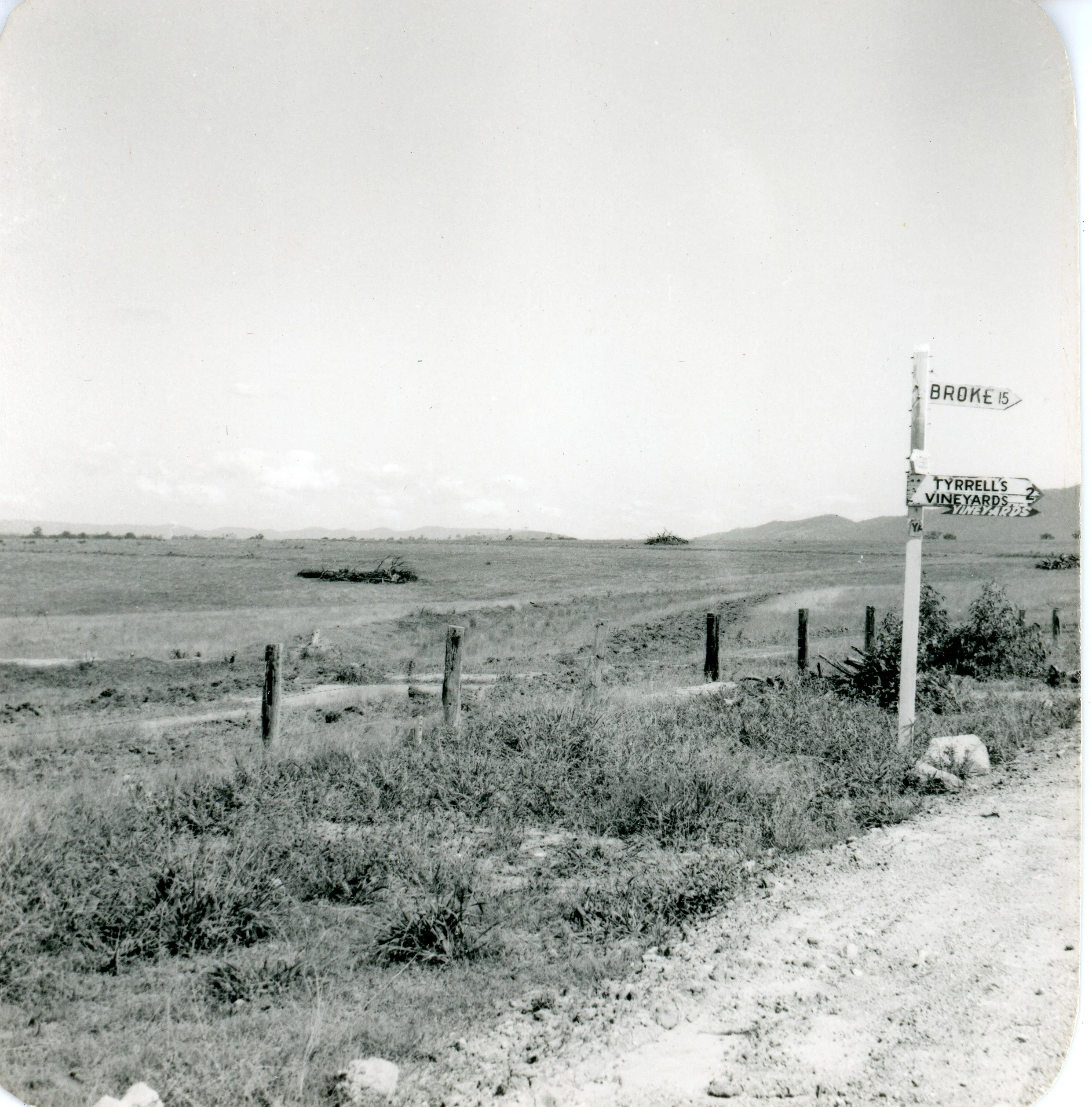
1969: Land being prepared for Hungerford Hill vineyard at Broke Rd intersection.
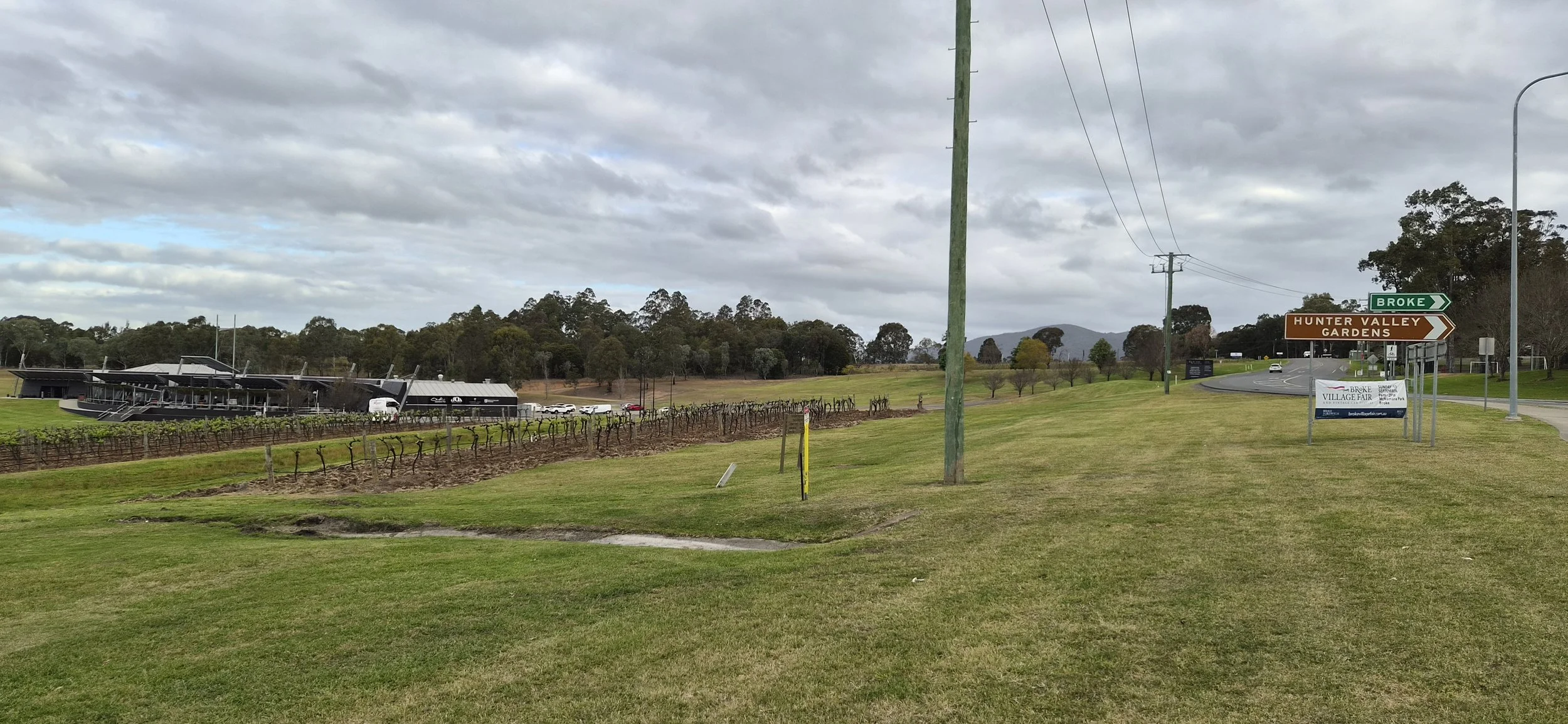
2026: Photo of land originally prepared for Hungerford Hill at Broke Rd intersection.
I told him that I'd written a report about what the company had been doing on the original Hungerford Hill paddocks, and he got really interested in that. He was also really interested in the photograph. I've now sent him all four photographs I took of the three paddocks, and a copy of the report. Understandably, he had no idea that anything like that report existed. I was also able to introduce Pierre to Simon Currant ─ now in his mid-eighties – having moved to Tasmania after his foundational years at Hungerford Hill. No doubt Simon will be able to provide Pierre with a thorough account of the early years of Hungerford Hill.
The happy end to this story is that Jan and I (and we presume Simon) are now invited to the 60th anniversary celebrations of Hungerford Hill next year.